
Key takeaways
- The domain is your address; the hosting is the computer that serves your site. They are separate services and can come from separate companies.
- Register the domain in your own name, with an account you control. It is the one piece of your site that is hardest to replace.
- Check the renewal price, not just the first year. Both domains and hosting are often discounted at the start.
- Shared hosting is enough for most small sites. Pay for more only when the site needs it.
- If you can answer yes to three questions, the site is yours: Is the domain in my name? Is the hosting account mine? Can I download a full backup?
Two words come up as soon as you start building a website, and they are often sold together, which makes them easy to confuse. They are different things, and keeping them separate is one of the simplest ways to keep control of your site.
The domain: your address
A domain is the name people type to reach you, such as yourbusiness.com. You do not buy it outright; you register it for a period, usually one year at a time, and renew it.
You register a domain through a registrar, a company accredited to sell domain registrations. Prices for a .com typically run from about $10 to $20 a year, depending on the registrar. Cloudflare’s registrar sells domains at the price it pays, without markup. Many other registrars offer a cheap first year and a higher renewal, so check the renewal price before you buy.
Register it in your own name. This matters more than anything else in this article. If a designer, an agency or a website builder registers your domain on your behalf, it may be in their name or their account. Getting it back can be slow and sometimes impossible. Use your own account, your own email and turn on two-factor login.
The hosting: where the site lives
Hosting is a computer, a server, that stores your site’s files and database and sends pages to visitors. You rent space on it, usually monthly or yearly.
For a typical small-business site, shared hosting is enough. Your site shares a server with others, which keeps the price low. Mainstream hosts advertise shared plans from a few dollars a month, often with a long first term and a higher price at renewal. Again, read the renewal price.
Larger or busier sites may need managed WordPress hosting or a virtual private server. You can move up when you need to; there is no reason to start there.
What to look for in a host:
- WordPress support. Most hosts install WordPress in a few clicks.
- Backups. Automatic daily backups that you can download, not just restore through their support team.
- A free SSL certificate. This gives your site
https. It should be included. - Email that works. Your site will send messages, such as form notifications. Check that the host supports outgoing email, or plan to use a separate email service.
Connecting the two: DNS
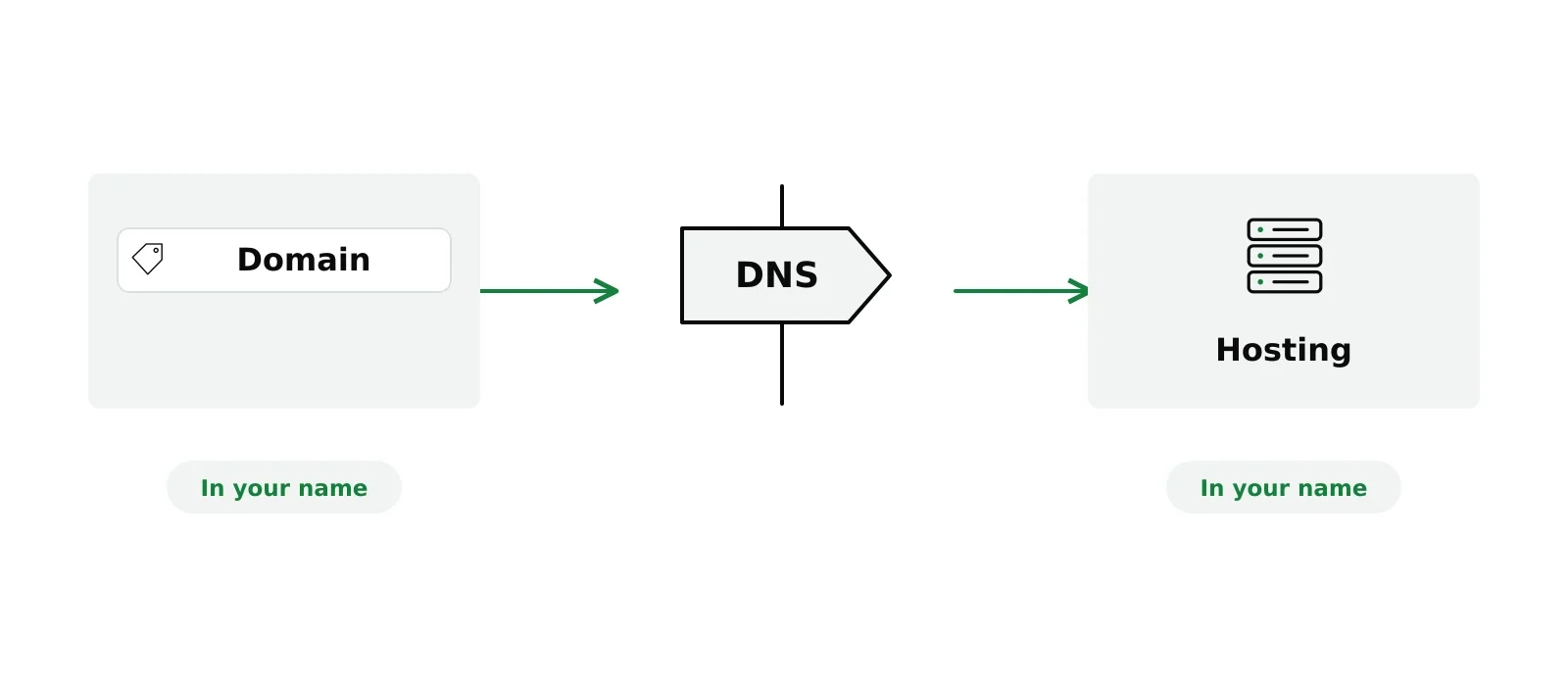
Once you have a domain and hosting, you connect them with DNS, the system that tells browsers which server a domain points to.
There are two common ways to do it:
- Change the nameservers. At your registrar, you point the domain to your host’s nameservers. The host then manages the DNS for you. This is the simplest option.
- Add records. You keep DNS at your registrar or with a DNS service and add an
Arecord pointing to your host’s IP address, plus a record forwww. This gives you more control.
Changes can take from a few minutes to a day or two to take effect everywhere. Your host’s documentation will list the exact values to use.
A word on Cloudflare
Many site owners put their DNS on Cloudflare. Its free plan includes DNS management and a content delivery network that can make your site faster and protect it from some attacks. It also keeps your DNS independent of your host, which makes moving hosts simpler later. It is optional, but it is a good habit.
Should you buy them together?
Many hosts offer a free domain for the first year. That is fine, as long as the domain is registered in your name and you know what renewal costs. The risk is mostly about moving: if your domain and hosting are in the same place and you want to leave the host, you have two things to move instead of one.
Keeping them separate, domain at a registrar and hosting at a host, costs a few dollars more and makes each one easier to change.
The three-yes test
Whatever you choose, you should be able to answer yes to three questions:
- Is the domain registered in my name, in an account I control?
- Is the hosting account mine, paid by me, with my login?
- Can I download a complete backup of the site, files and database, whenever I want?
Three yeses mean the site is yours. Any no means someone else can decide what happens to it. We go further into this in the website you’re renting.
Next steps in the process: how to build a website covers what comes after, and move WordPress site to new host covers changing hosts later.
Where NoTiesBuilder fits
NoTiesBuilder is our product and is launching soon. It will not sell domains or hosting. It will deploy your site to the hosting account you already have, so both stay in your name and you pay those providers directly.
Frequently asked questions
What is the difference between a domain and hosting?
The domain is the address people type. The hosting is the server that stores and serves your site. You need both, and they can come from different companies.
How much do a domain and hosting cost?
A .com domain typically costs about $10 to $20 a year. Shared hosting starts at a few dollars a month, usually with a higher renewal price after the first term.
Can I move my domain to another registrar?
Yes. Domains can be transferred between registrars, after a lock period that follows registration or a previous transfer, currently 60 days at most registrars. You unlock the domain and get a transfer code from your current registrar.
Do I need a separate email host?
Not necessarily. Many hosts include email. A separate email service is often more reliable and keeps your email working if you move hosts.